Flaking mill equipment turns grain, oilseed or pre-cooked material into a flat, uniform flake by passing it between two closely set rolls. The equipment in this section covers the whole flaking duty: dehulling and cracking the raw material, conditioning it with heat and moisture, pressing it into a flake, and then cooling and stabilising the finished product.
WUXI HASEN IMPORT AND EXPORT CO., LTD supplies flaking and cracking machinery, individual machines and replacement parts to cereal processors, oilseed plants, oat mills, brewers and feed producers across Asia, the Middle East, Africa and South America. We are a supplier and export partner rather than a machine tool builder, so our work sits in defining the duty, sourcing the machine that matches it, inspecting it before shipment and keeping the plant supplied with the parts that wear.
What a flaking operation covers
Flaking is a mechanical process, but the result is decided mostly by what happens before and after the rolls.
- Cleaning and dehulling - removing foreign matter and separating the shell or hull from the kernel.
- Cracking and sizing - breaking the kernel into a controlled granulation the rolls can flake evenly.
- Conditioning - adding heat and moisture so the material becomes plastic and flakes rather than shatters.
- Flaking - passing the conditioned material between rolls set to a target gap and pressure.
- Cooling and drying - bringing temperature and moisture back to a stable, storable condition.
- Product handling - conveying and screening finished flakes without breaking them.
Dehulling, shelling and cracking
Flake quality starts with a clean, evenly sized feed. Grain dehullers and cotton seed shellers separate the hull or shell from the kernel, and cotton seed removal machines are used where the fibre still has to be taken off before the seed can be processed at all. Material that reaches the flaking rolls with residual shell produces a flake with hard inclusions and an uneven surface.
Cracking mills reduce the kernel to a controlled granulation before flaking. A cracker that is set too coarse leaves whole kernels that the flaking rolls simply crack, and a cracker set too fine produces fines that compact into a weak, dusty flake. The cracker setting and the roll gap downstream have to be treated as one decision rather than two.
Conditioning before flaking
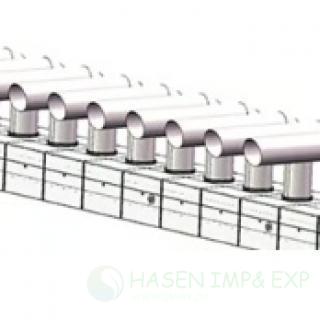
The steam chest cooling and drying system is the part of a flaking line that is easiest to underestimate. Its job is to bring the material to the temperature and moisture at which it becomes plastic enough to form a coherent flake, and to hold it there long enough for the heat and moisture to even out through the kernel. Material that is conditioned on the surface only will flake unevenly, with soft centres and brittle edges.
Water-cooled cracking is used where the process generates more heat than the product can tolerate. Cooling the cracking stage protects the material from heat damage and keeps the downstream flake consistent, and it matters most in oilseed and pre-cooked processes where the product is heat sensitive.
The flaking duty itself
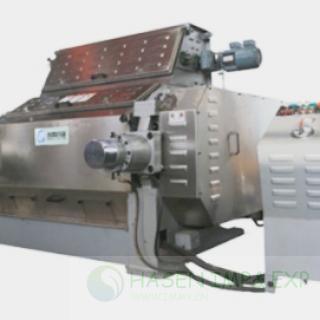
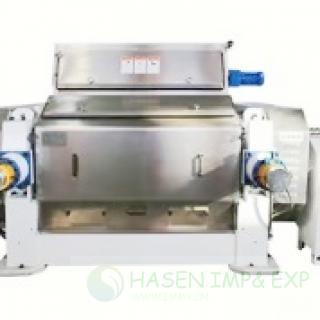
Flaking machines are defined by roll diameter, roll length, roll hardness and surface, the hydraulic or mechanical pressure they can apply, and the precision with which the gap can be set and held. For a given material, the achievable flake thickness is limited by how much pressure the machine can apply without the rolls deflecting, which is why roll diameter and length are not interchangeable between applications.
Corn flaking machines, for example, are built around the requirements of the breakfast cereal and snack process, where flake thickness has to be consistent across the full width of the roll. Oat flake machines work a softer, higher-fat material that needs different roll surface and gap settings from corn. A machine set up for one rarely performs well on the other without reconfiguration.
Pre-cooked and speciality flakes
Pre-cooked flake machines handle material that has already been cooked or partially gelatinised, which changes both the pressure it will accept and the way it releases from the roll. These lines are usually specified together with the cooking and cooling stages rather than as a standalone machine, because the flake quality depends on the temperature and moisture profile the material arrives with.
Cooling, drying and product handling
Freshly flaked material is warm, moist and fragile. Steam chest cooling and drying systems bring it down to a stable condition, and the dwell time between flaking and packing is what prevents the flake from compacting or going mouldy in storage. Conveying needs to be gentle: pneumatic lines and high-drop transfer points are a common source of broken flakes and fines, and the fix is often a change of conveying method rather than a change of machine.
Spare parts and wear items
Rolls and roll reconditioning, hydraulic components, bearings, seals, doctor blades, scrapers, drive belts and screen elements wear on a schedule. Roll surface condition decays gradually and is easy to live with until flake quality drops, so we supply replacement rolls and reconditioning support as well as the consumables around them. Where a plant runs machines from several original suppliers, we consolidate those items into one shipment and one document set.
How we work with you as a supplier
Our contribution is on the specification, sourcing, inspection and logistics side of the transaction:
- Requirement definition - we start from your material, target flake thickness, capacity and existing line layout, not from a fixed catalogue.
- Machine and part matching - for replacement items we work from dimensions, photographs and part numbers so what arrives fits what you have.
- Inspection before shipment - dimensional checks, function tests and photographic records of the actual unit being shipped.
- Documentation - packing lists, invoices and the shipping papers your customs broker asks for, prepared to match the shipment.
- Consolidated shipping - machines, spares and accessories combined into one consignment to reduce freight and clearance cost.
- After-sales support - installation guidance, commissioning support and a route to reorder the same wearing parts.
Frequently asked questions
Can you supply a single flaking machine or roll set?
Yes. Replacement rolls, roll reconditioning and single machines are all normal business for us. Small orders ship by air or LCL, complete lines by FCL.
Why are my flakes coming out uneven or broken?
The usual causes are a feed granulation that is too coarse or too fine, insufficient conditioning, and roll surface or gap condition. We will work through those in order rather than start by replacing the machine.
Can one machine handle corn, oats and oilseeds?
Sometimes, but not usually well. Soft, high-fat materials and hard cereal grains need different roll surfaces and gap settings, so most plants that flake more than one product run more than one configuration.
Can you match a machine to a line built by another supplier?
Usually yes. Send the machine nameplate, key dimensions or a photograph with a tape measure visible, and we will confirm whether an equivalent or a modified item is the practical route.
Talk to us about your flaking line
Send us the material you are flaking, the target flake thickness, the capacity you need and a photograph or drawing of the existing line if you have one. We will come back with the equipment list, the options that matter and the questions that still need answers before a quotation is meaningful.



 Call us:
 Wuxi Hasen sales